
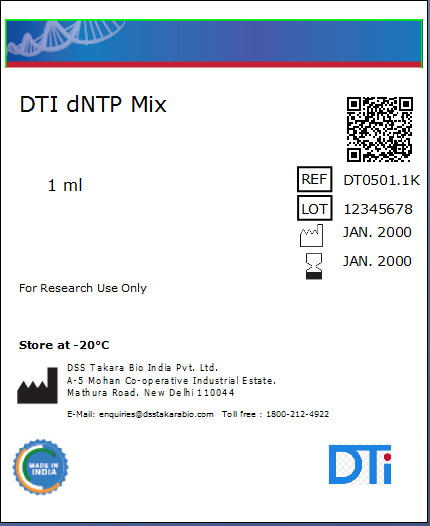
Our dNTPs for PCR are ≥98% pure and are tested for quality control in a variety of applications. Individual dNTPs are supplied at a concentration of 10 mM and can be diluted with water or buffer as needed. The mixture contains each dNTP at a concentration of 10 mM.
| Brand | Catalogue Number | Pack Size |
|---|---|---|
| DTI dNTP Mix | DT0501.1K | 1 ml |
DTI dNTP Mix – Protocol
Instructions for use and step-by-step protocol.
DTI dNTP Mix – Certificate of Analysis (DT0501.1K)
Batch-specific quality control results.
Consistent amplification of 500 bp fragment from λ DNA is observed using 10 mM dNTP in the RR002M TaKaRa LA Taq® DNA Polymerase (Mg2+ plus buffer) PCR system.
The protocol used for the assay and the results are as follows:

Figure 1: Amplification of 500 bp fragment from λ DNA using dNTP in the PCR system.
Consistent amplification in RT-PCR was confirmed using total RNA from HL60 cells as a template (amplified fragment: TFR region 4.4 kbp). dNTP has been used in the Takara cat# PrimeScript™ RT-PCR Kit RT PCR system.
The protocol used for the assay and the results are as follows:

Figure 2: RT-PCR amplification using dNTP in the PrimeScript™ RT-PCR Kit.
Magnesium is a required cofactor for thermostable DNA polymerases and is important for successful amplification. Without adequate free Mg2+, PCR polymerases are not active. In contrast, excess free Mg2+ reduces enzyme fidelity and may increase nonspecific amplification. A number of factors can affect the amount of free Mg2+ in a reaction, including DNA template concentration, chelating agents in the sample (e.g., EDTA or citrate), dNTP concentration, and the presence of proteins.
Successful PCR requires that the DNA duplex separates during the denaturation step and that primers anneal to the denatured DNA. Salt neutralizes the negative charges on the phosphate backbone of DNA, stabilizing double-stranded DNA by offsetting negative charges that would otherwise repel one another. Potassium chloride (KCl) is normally used in PCR amplifications at a final concentration of 50 mM. To improve amplification of DNA fragments, especially fragments between 100 and 1,000 bp, a KCl concentration of 70–100 mM is recommended. For amplification of longer products, a lower salt concentration appears to be more effective, whereas amplification of shorter products occurs optimally with higher salt concentrations. This effect is likely because high salt concentration preferentially permits denaturation of short DNA molecules over long DNA molecules.
It is important to note that a salt concentration above 50 mM can inhibit Taq polymerases.
All primer pairs used in multiplex PCR should have similar priming efficiencies for their target DNA. This can be achieved by using primers with nearly identical optimum annealing temperatures.
When designing primers, pay special attention to the following parameters:
Nested PCR is a method that involves re-amplification to improve PCR results. Nested PCR involves designing a new forward-nested (FN) or reverse-nested (RN) primer that is internal to the original primer and can pair with the original partner primer. A very small amount of the primary PCR product is used as a template for PCR with nested primers.
Nested PCR frequently leads to improved yield of the desired PCR product by:
It is important to note that only a very small amount of the primary product should be used in nested PCR because this template has very low sequence complexity. To start, the primary PCR product can be diluted 1:100, and 1 µl can be used as the template for nested PCR. Also, you may need to reduce the number of cycles to 25–30. The optimal conditions for nested PCR should be determined empirically.
During the PCR denaturation step, all DNA molecules will become single stranded. When the temperature decreases for annealing, three types of duplexes can be formed:
To achieve higher specificity, heteroduplex formation should be minimized by increasing stringency (i.e., increasing the temperature) during the initial PCR cycles. Touchdown PCR increases specificity by using reaction conditions that gradually reduce the annealing temperature. The initial annealing temperature is set to several degrees above the estimated Tm of the primers. In subsequent cycles, the annealing temperature is slowly decreased until it reaches the calculated annealing temperature of the primers (Don 1991). By using a higher annealing temperature in the initial PCR cycles, touchdown PCR favors accumulation of amplicons for sequences with the highest primer-template complementarity, thereby enriching for the most specific amplicons. Transitioning to a lower temperature during subsequent cycles reduces stringency, improving priming conditions with the already enriched, desired template. We recommend performing an initial 5–10 cycles with the higher annealing temperature, and then gradually decreasing the temperature until the optimal annealing temperature, or “touchdown temperature,” is reached. For example, if the Tm of your primers is 68°C, the recommended TD-PCR conditions for the annealing temperature are:
Reference: Don, R. H., et al. ‘Touchdown’ PCR to circumvent spurious priming during gene amplification. Nucl Acids Res. 19(14):4008 (1991).
The fidelity of a DNA polymerase refers to its ability to accurately replicate a template, or to add the correct nucleotides starting at the 3′ end of the primer. The rate of base misincorporation is known as the error rate. PCR polymerases with proofreading activity possess 3′→5′ exonuclease activity that can excise incorrectly incorporated nucleotides and replace them with the correct nucleotides.
High-fidelity polymerases are recommended for gene cloning, protein expression, structure-function studies of proteins, cDNA library construction, and next-generation sequencing.
To avoid contamination, gloves should be worn when handling enzyme tubes, and fingers should be kept away from the tube opening. It is imperative to use a new, clean pipette tip every time you draw from a stock tube of enzyme.
When pipetting enzyme from a stock tube, place the end of the tip just far enough into the liquid to obtain the desired volume. A pipette tip should not be plunged all the way into the enzyme solution as the outside of the tip will become covered with enzyme, preventing accurate measurement and wasting enzyme.
Note: The retention of liquids to polypropylene tips varies with different types of solutions. Pipette tips lose their precision when liquid is drawn more than once. Low-retention pipette tips are recommended for use with viscous solutions, such as those containing glycerol.