
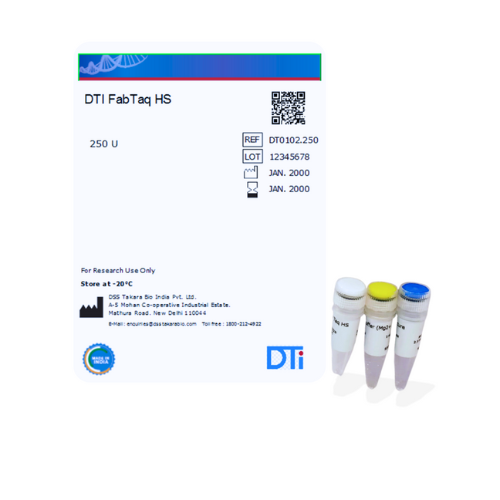
DTI FabTaq HS
PCR Polymerase Enzyme

DTI FabTaq HS

DTI FabTaq HS DNA Polymerase is the hot-start version of our high-performing DTI FabTaq polymerase offering high yield, excellent sensitivity, and fidelity that is 4.5 times higher than Taq polymerase. Antibody-mediated hot-start gives lower background, higher specificity, and allows room temperature reaction assembly. DTI FabTaq HS DNA polymerase is supplied with 10X buffer (Mg2+) and dNTP mix.

Catalog & Pack Sizes
DT0102.250 250 U

Key Highlights

  • Lower background, increased specificity, and room-temperature reaction assembly.
  • Ideal for demanding applications requiring maximum sensitivity.
  • Provides consistent and reliable results on complex or challenging templates.

Documents & Downloads

Download product manuals, certificates, and technical resources below.

PDF

DTI FabTaq HS - Protocol

Instructions for use and step-by-step protocol.

Download User Manual
PDF

DTI FabTaq HS - Certificate of Analysis (250 U)

Batch-specific quality control results.

Download CoA - DT0102.250
PDF

DTI FabTaq HS - Promotional Document

Promotional overview and ordering information.
Download Flyer

DTI FabTaq HS Performance Comparison

Results

Comparison with DTI FabTaq HS DNA polymerase

The performance of DTI FabTaq HS in a multiplex reaction was compared to its performance in single-target reactions, and to that of the standard DTI FabTaq DNA Polymerase in a multiplex reaction (Figure 1). DTI FabTaq and DTI FabTaq HS were each used to amplify a human genomic DNA template with eight different primer pairs, each specific for a target ranging from 84 to 432 bp in size. In addition, DTI FabTaq HS was used to perform an individual amplification reaction with each of the eight primer pairs.

The sample amplified using DTI FabTaq HS (Lane 10) shows more efficient multiplex amplification of all the bands individually amplified in Lanes 1–8 than the sample amplified using DTI FabTaq (Lane 9), and it lacks the low molecular weight non-specific amplification band seen with DTI FabTaq (Lane 9). The intensities of the bands in Lane 10 are comparable to the intensities of the corresponding individual bands in Lanes 1–8, indicating that DTI FabTaq HS provides multiplex efficiencies comparable to those observed in individual amplification reactions.

Application data figure 1

Figure 1: Comparison of DTI FabTaq and DTI FabTaq HS DNA polymerases in multiplex PCR reactions.

Comparing the ability of DTI FabTaq DNA Polymerase Hot Start Version to amplify human genomic DNA fragments to that of the standard DTI FabTaq DNA Polymerase. PCR reactions were performed using human genomic DNA as a template and primer pairs for eight different targets. Lanes 1–8 contain individual reactions for each primer pair amplified using DTI FabTaq HS. Lanes 9 and 10 contain multiplex PCR reactions performed with all eight primer pairs in a single tube, amplified with either the standard Taq DNA polymerase (DTI FabTaq, Lane 9) or DTI FabTaq HS (Lane 10).

Conclusion: This experiment demonstrates that target amplification efficiencies for multiplex PCR using DTI FabTaq HS are comparable to efficiencies observed for separate (single target) amplification reactions. In addition, DTI FabTaq HS demonstrates superior efficiency and specificity over standard Taq polymerase (DTI FabTaq) in this multiplex-PCR application.

Methods:
PCR cycling conditions for individual reactions:
1 cycle at 94°C for 30 sec, followed by 30 cycles of 94°C for 30 sec, 55°C for 30 sec, and 72°C for 60 sec.

PCR cycling conditions for multiplex reactions:
1 cycle at 94°C for 30 sec, followed by 30 cycles of 94°C for 30 sec, 57°C for 30 sec, and 72°C for 60 sec, followed by a final step at 72°C for 90 sec.

Frequently Asked Questions

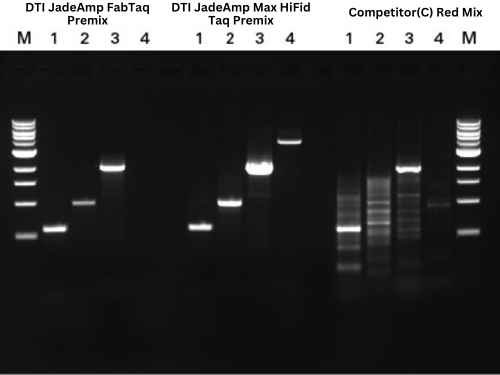
We recommend DTI JadeAmp FabTaq Premix (Cat.# DT0201.320). This product is completely premixed, making it easy to prepare PCR reaction mixtures which can be loaded directly on an agarose gel for electrophoresis after the reaction. For an efficient workflow with minimal pipetting, DTI JadeAmp FabTaq Premix contains a green tracking dye. Additionally, a density agent is included to aid in gel loading.

DTI JadeAmp FabTaq Premix can amplify targets up to 10 kb in length, including targets that are GC- or AT-rich. Additionally, PCR products generated with DTI JadeAmp FabTaq Premix can be used directly for restriction enzyme digestion, sequencing, or TA-cloning without the need for further purification.
We recommend DTI CobaltAmp HiFid Taq HS Premix for colony PCR. These enzyme preparations tolerate the presence of substantial bacterial nucleic acid carry-over. Because tracking dye and density agent are included in these master mixes, the PCR reaction mixtures may be loaded directly on an agarose gel for electrophoresis.
DTI CobaltAmp HiFid Taq HS Premix is an economical choice for high-throughput projects. This enzyme is formulated to include high-speed polymerase, optimized buffer, dNTP mixture, gel loading dye (blue), and a density reagent in a 2X premix. Since it requires an extension time of only 10 sec/kb, colony PCR reactions can be completed in less than 1 hour for inserts up to 1 kb.
DTI FabTaq and DTI FabTaq Hot Start Version enzymes are compatible with inosine-containing primers. It is important to note that inosine-containing primers should not be used with PCR enzymes that have 3’→5’ exonuclease activity. When using one of these PCR enzymes, we recommend using mixtures of degenerate primers with A, T, G, and C at the desired position(s) rather than inosine-containing primers when performing degenerate PCR.
DTI FabTaq and DTI FabTaq Hot Start Version enzymes primarily yield amplification products containing 3’-dA overhangs, which facilitates TA cloning.
The optimal amount of template required depends on the complexity of the template and the copy number of the target sequence. Approximately 10⁴ copies of the target DNA sequence are required to detect the amplification product in 25–30 PCR cycles.

• Typically, 1 µg of human genomic DNA contains 3.04 x 10⁵ molecules of DNA. For most PCR applications, 30–100 ng of human genomic DNA is sufficient. High-copy targets, such as housekeeping genes, require only 10 ng of template. Template amounts for higher-complexity templates range between 10 ng and 500 ng.
• Typically, 1 µg of E. coli genomic DNA contains 2 x 10⁸ molecules of DNA; therefore, the recommended amount of template is between 100 pg and 1 ng.
• Typically, 1 µg of lambda DNA contains 1.9 x 10¹⁰ molecules of DNA; therefore, the template input can be as little as 100 pg.
• The amount of cDNA template depends on the copy number of the target. cDNA input is typically described in terms of equivalent RNA input. The amount of cDNA in a PCR reaction can be as little as 10 pg (RNA equivalent).

For some polymerases, excessive template tends to inhibit amplification. In contrast, some DNA polymerases tolerate a broader range of template quantity. In general, reaction conditions may be adjusted depending on the type, quantity, and quality of the template.